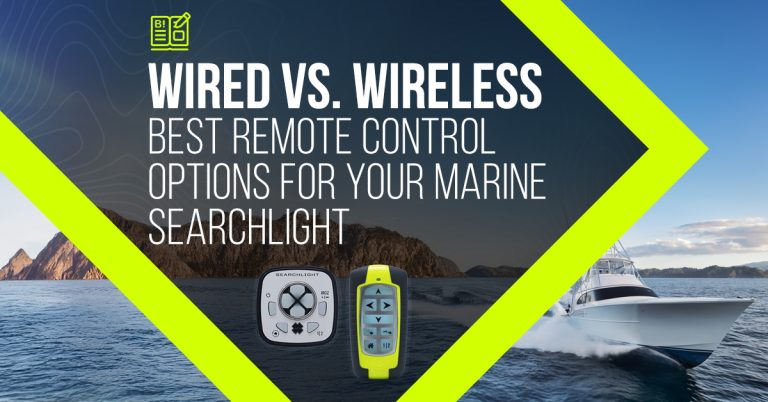
Control Options for Marine Searchlights: Wired vs. Wireless - Which is Best for You?
Posted on August 29, 2025
When you’re out on the water at night—navigating tight marinas, scanning for obstacles, or searching for buoys—a reliable marine searchlight can be your best friend. But just as important as the light itself is how you control it. This blog focuses on the pros and cons of the different control options for marine searchlights.
Today’s marine searchlights come equipped with advanced remote control options, primarily wired and wireless systems (Click here to view ACR’s most popular searchlight option – the RCL-100 LED). Each has its strengths and trade-offs, and choosing the right one depends on your boat, your needs, and your preferences. Let’s break it down.
Wired Remote Control Systems:
Pros:
- Reliability in Harsh Conditions
Wired systems are physically connected and less prone to interference. This makes them highly reliable in environments with lots of moisture, signal-blocking structures, or electronics. - No Signal Loss
Since the connection is direct, you don’t have to worry about losing control due to signal dropouts or battery failures in a remote. - Consistent Power Supply
Wired controls draw power from the boat’s electrical system, meaning no batteries to replace or charge. - Secure & Tamper-Proof
They’re less vulnerable to unauthorized control or accidental interference from other wireless devices onboard.
Cons:
- Installation Complexity
Running wires through your boat can be time-consuming and may require drilling, especially in retrofit situations. - Limited Flexibility
Control is typically fixed to the helm or a panel, meaning you need to be physically present at that location to operate the searchlight. - Aesthetics
More cabling means potential clutter, especially on boats where clean lines and minimalism matter.
Wireless Remote Control Systems:
Pros:
- Freedom of Movement
Wireless remotes allow you to control the searchlight from anywhere on your boat—at the stern, bow, or even below deck. - Easy Installation
No need to run cables through bulkheads or consoles. Most systems pair quickly and are ready to go in minutes. - Great for Solo Boaters
If you often manage your boat alone, having the ability to adjust the searchlight while handling lines or approaching a dock is a game-changer. - Portable Redundancy
You can have multiple remotes—or even backup a wireless system with a wired override—for added flexibility.
Cons:
- Signal Interference
Other onboard electronics, metal structures, or even extreme weather can affect wireless performance. - Battery Dependency
Wireless remotes require battery power. A dead remote at the wrong time could leave you without control unless you’ve got a backup. - Security Risks
Though rare, wireless remotes could be susceptible to interference or unintentional control from nearby signals if not encrypted.
Which of the different control options for marine searchlights is Right for You? The best option depends on how you use your boat. For large vessels or yachts with enclosed helms, redundant systems, and permanent crews, wired systems provide reliability and integrate well with other electronics. For recreational boaters, center consoles, or sportfishing boats where mobility and quick installs matter, wireless systems offer unbeatable convenience. All of this being said, an increasingly popular option is to employ a Hybrid Solution. Many high-end searchlight systems now offer dual control options—wired at the helm and wireless from anywhere on the vessel. This gives you the best of both worlds.
Choosing between the different control options for marine searchlights comes down to balancing reliability, convenience, and your vessel’s setup. Whether you favor the time-tested dependability of a wired system or the modern flexibility of a wireless remote, make sure your control system suits how you operate—because when visibility matters, control is everything.
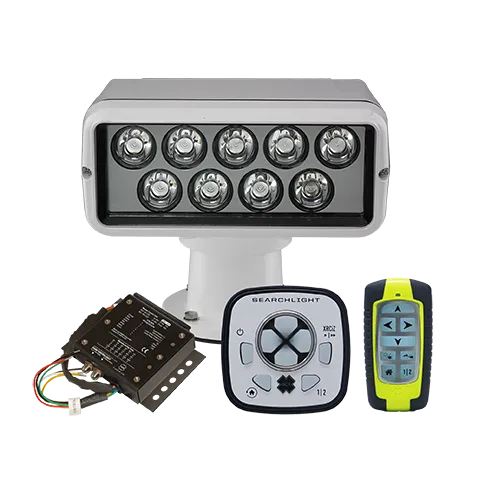
See below for the wide variety of searchlight kits from ACR Electronics featuring new control options:
| Part # | Description |
| 1978 | RCL-100 LED, White, with new URC-104 Master Controller and URP-103 Point Pad |
| 1979 | RCL-100 LED, Black, with new URC-104 Master Controller and URP-103 Point Pad |
| 1982 | RCL-50 LED, White, with new URC-104 Master Controller and URP-103 Point Pad |
| 1983 | RCL-50 LED, Black, with new URC-104 Master Controller and URP-103 Point Pad |
| 1976 | RCL-100 LED, White, with new URC-104 Master Controller, URP-103 Point Pad, & URH-103 Handheld Wireless Remote |
| 1977 | RCL-100 LED, Black, with new URC-104 Master Controller, URP-103 Point Pad, & URH-103 Handheld Wireless Remote |
| 1980 | RCL-50 LED, White, with new URC-104 Master Controller, URP-103 Point Pad, & URH-103 Handheld Wireless Remote |
| 1981 | RCL-50 LED, Black, with new URC-104 Master Controller, URP-103 Point Pad, & URH-103 Handheld Wireless Remote |
| 1975 | Universal Remote Control Kit (URP-103 point pad, URC-104 master controller, & URH-103 handheld wireless) |
| 1984 | Retrofit Kit (URP-103, URC-104, & URP-103 Retrofit Plate Cover) – For users wishing to upgrade their old RCL-100 LED control accessories to the new URP-103/URC-104. |