Lives saved
1

Hiking

Mountain
Weather
Thunder storm
Spruce Flats Falls, Townsend, TN, USA
35.6342938°N, -83.6819544°W
Posted on August 9, 2020 by Scott (Nadi) Gray
What happened?
Spruce Flat Falls in the Great Smoky Mountains National Park consists of four waterfalls, each between 15-50’ high. Most people visit the largest (estimated 50’ / 15M height) waterfall by hiking a trail that originates at the Tremont Institute. The trail is nice but the locals like me cut out the time the hike takes, by passing the Tremont Institute trailhead then take a gravel road up about a mile, park, cross a stream, then climb a small (estimated 20’ / 6M height) waterfall that brings you to the end of the trail at the largest waterfall. Once arriving at the second waterfall, a few people follow a ‘worn’ path to the third (estimated 40’ / 12M height) waterfall and far fewer, including me a few times, just free climb it. This is really a story about the fourth waterfall (estimated 35’ / 10M height).
I had been to the first three falls many times over the years and in early July 2020, while at the third waterfall with my now ex-wife, her two children, and my sons Elliott and Christian, Christian speculated there might be a fourth waterfall above it. We didn’t have time to explore it then but knew I would another time.
A couple of weeks later, on July 25, 2020, that chance arrived. My ex-wife and I took her two children, two of her friends and their two children to Spruce Flat Falls. We took the shortcut across the stream and over the small lower falls to reach the second and largest falls. After reaching it, I decided to investigate Christian’s hunch and our friend’s 16yo son decided to join me. After reaching the third fall via the worn path, we climbed up non-existent trails to discover Christian was right. There was a fourth waterfall. We then hiked upstream through brush to find there were no more waterfalls. On our return, the young man crossed upstream from the waterfall and I was on a ledge 5-10’ above the lip of the waterfall scouting the best way out. I did not find the best way because something gave (rock, ledge, moss?) and within an instant I was staring down the barrel of a fall cushioned only by rocks with a large fallen tree at the bottom. I had just enough time to brace against the first major impact using my right hand, then all went black.
I later learned from the young man that he watched me hit the rocks on the way down then land on my back across the fallen tree at the bottom. When he reached me, I was motionless, silent. He thought I was dead. He then made his way down to my then wife, told her what happened, and guided her and his Dad back up to me.
When they arrived, they found me 20-25’ downstream from the tree I landed on, on the other side of the stream, up to near my waist in the water and unconscious with open eyes that seemed to stare at nothing. While I have no memory from the time I hit my wrist on the first ledge until I regained consciousness where they found me, I have a very good idea of what happened. Probably 95% of my hours in the backcountry are spent alone. This means when I regained consciousness I very likely thought “I am going to die if I cannot get help and the only way to get it is find my ACR rescue beacon”. With that in mind, I assume I rolled on my “best” side (side with only two broken ribs) then scooted to a limb (which fortunately had not impaled me) then used it to slide to the ground. I would have then crawled looking for my backpack to trigger the beacon’s satellite signal. When I didn’t see it, I likely thought it must have floated downstream. I was right and wrong. My backpack was downstream but with my then wife two waterfalls below as I was not alone this time.
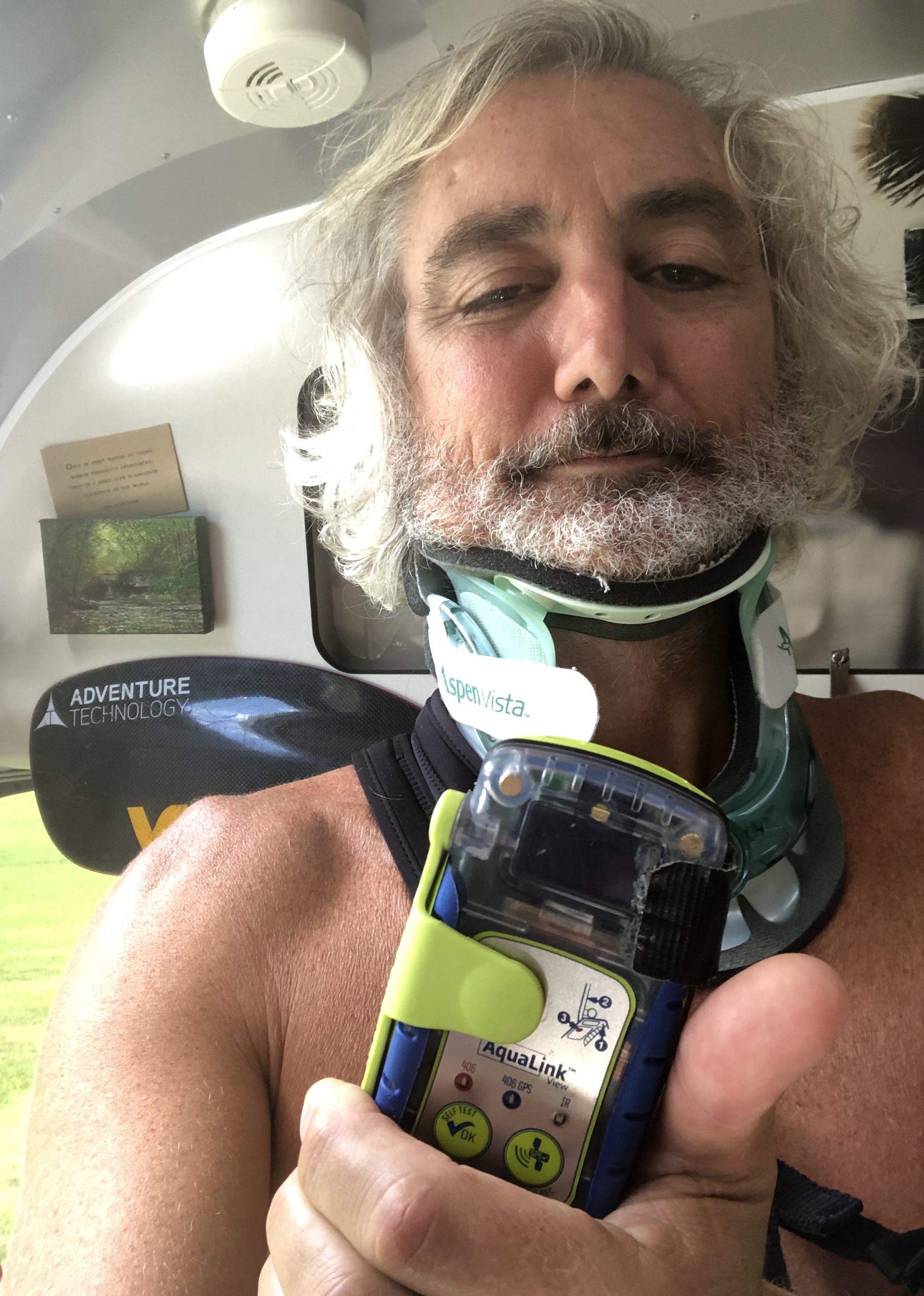
When she, her friend, and his son arrived I was unconsciousness again. My ex-wife told me that my eyes were open and I was breathing but it was as if I was not there. In that moment, I was experiencing a state of consciousness one step removed from sensory consciousness. It was if I was in a colorless sphere with no definition to see, no sound, no feeling, no smell, no taste and most importantly, no pain. In that sphere of consciousness, I was having a conversation with myself as we do throughout our lives. I kept asking the question, “are we ready” and kept answering, “no, no yet.” Then at a certain point, the reply changed to a “yes” and in an instant the tree canopy above me came into view, the roar of the waterfall pierced my ears, and most importantly, I now experienced the tremendous pain of my injuries. I was not very coherent, just moaning a lot. I could not be moved as it was not known if I had broken my neck or back (in fact I had broken vertebrae in both). My ex-wife’s friend left to try and find rangers or a cell signal as cell phones do not work in the National Park. My ex-wife then remembered my beacon and asked the young man to see if it was in my daypack. He returned with it and after showing them how to deploy the antennae, the rescue began. Given the remote location of the upper fall, with no trails coming into it, it took the first Park Service EMT over two hours to reach me. During the wait, I had been fighting hypothermia. The milestones of the rescue, best I remember or I have been told, included:
Hours 1 and 2 after the fall: The young man went down on his own to notify them of what had happened, brought them back up to me, then went down and back up again with the beacon. A lifesaver. My ex-wife was then my lifeline for two additional hours until Dillon, the EMT, arrived. I doubt I would have made it without her. Another lifesaver. She stayed there not knowing if I would make it and when she saw me going hypothermic, she reminded me to execute my ice-water survival training. Her friends also took care of the younger kids and got them safely back.
Hour 3: Dillon Jones (Park Service EMT) arrives with a couple of assistants. With Kelley helping, they extract me from the water to halt the worsening hypothermia. They cannot hear my lungs over the sound of the falls, but my breathing is shallow so fractured ribs, collapsed or bleeding into lung(s) are suspected. Later, we learn I had broken two vertebrae in my neck, one in my lower back, seven ribs, ripped by left arm completely from the tendons attaching it to my clavicle and shoulder, burst left ear drum, bleeding in my lungs, laceration to my left hips, sprained wrist, and of course, severe hypothermia. They cover me with as much as they can to combat the hypothermia and get a helmet on my head.
Hour 4: Dr. Rusty Miller, doctor at Children’s hospital and Park Service volunteer, arrives and with Dillon tries each hand, foot, arm, leg to get an IV without success. They eventually perform I/O procedure by piercing my shin bone with success and finally I was given something for pain. They, along with BUSAR (Backcountry Unit Search and Rescue), plan for and begin preparing multiple contingencies for over the ground rescues as the National Guard chopper is delayed due to weather three different times. They move me across the stream for extraction over very hazardous terrain below the falls.
Hour 5: National Guard dispatches Blackhawk helicopter for the fourth time and the crew reaches the GPS location sent by beacon. Two National Guard rescue specialists/medics are lowered down to me, secure me to a gurney for extraction.
Hour 5 +15 min: National Guard Blackhawk helicopter pulls me up (I had broken ribs before and when the gurney wrapped around me tight when lifted left no doubt I had again). As I reached the tree canopy, the gurney must have touched and began rocking then the gurney began spinning rapidly with the rotors. The helmet they placed on my head saved my life because my head made impact with the chopper to stop the spinning. It cracked the helmet instead of my skull. Thankfully, they retrieved then revived me immediately (I saw someone right above me on the edge of the chopper bay right before things went black again and came to after being given something up both nostrils). For the first time in over five hours, I felt like I could quit fighting to stay alive, that now I was past the danger zone. According to what I was told, the flight took 12 minutes. I remember being harnessed in securely but not landing. The next thing I remember were hallway ceiling lights whirling by as they ran me through the halls of the University of Tennessee Medical Center’s Trauma Unit ICU.
During those 5+ hours, several times I was given something up my nostrils to “come to” or “come back”. I heard, “Stay with me Nadi” more than I can count (Nadi is the name everyone calls me). During those hours, many heroes, starting with my ex-wife, the young man who was with me when I fell, Dillon, Rusty, BUSAR, and the National Guard rescue teams, then the UTMC Trauma Center doctors, surgeons, and nurses pulled me through minute by minute, step by step.
Once stabilized and assessed in ICU, I was found to be very blessed. In spite of seven fractured ribs, three fractured vertebrae, a shattered shoulder and dangling arm, bleeding in my lungs, two concussions, two lacerations requiring staples, a damaged ear drum, and severe hypothermia, I had NO paralysis, no life-threatening organ damage, no skull fracture, and no lasting consequence from hypothermia. Five months after the accident, I began having seizures and it was only then we discovered I suffered a brain hemorrhage. It had resolved (bleeding had stopped) but it the traumatic brain injury was and is the most serious of the injuries in terms of impact on my life. I updated this story after filling in many gaps after talking to those who saved my life. It took an enormous amount of rehabilitation, surgery to rebuild my arm and shoulder using cadaver tendons and an amazing medical device/pulley system, but after 19 months, I climbed all four waterfalls again and two years after, two of my sons accompanied me on my first multi-day/night backpacking hike.
Words of wisdom
When suffering hypothermia, imagine a time and place, not so faraway, under a warm blanket.
When someone who loves you, stays with you while they think you may not make it, always remember that your suffering is nothing compared to theirs.
Thank you note
My journey to safety began with the movie 27 hours. After seeing it, I began telling someone where I was going. My journey continued when my friend told me about Aqualink View. I carried it past many a rattlesnake, riled up bear, but never used it. It was truly when I least expected it, my then wife, not I, pushed the button and, almost certainly, meant the difference between my living or dying that day. If you are someone who spends time in the backcountry, alone or with others, I know there are other options for communications as I use them, but there is never a backcountry adventure that begins for me without my ACR beacon in my pack. It is the gold standard for survival.
Rescue location
Spruce Flats Falls, Townsend, TN, USA
Rescue team
Other
