 light bars
Marine LED Searchlights vs. Light Bars: A Compliance and Safety Perspective
Posted on April 29, 2026
As LED lighting becomes more common on recreational and commercial vessels, so do questions around regulatory compliance and safe use. While marine LED light bars are widely available and often marketed for marine use, their application, particularly while underway, can raise serious compliance and safety concerns.
By contrast, marine LED searchlights are purpose-built for navigation and align far more closely with established maritime safety standards. This blog focuses on marine searchlights and light bars and how each lighting type fits within regulatory expectations, especially regarding glare, visibility, and the risk of blinding other boaters.
What Is a Boat Searchlight?
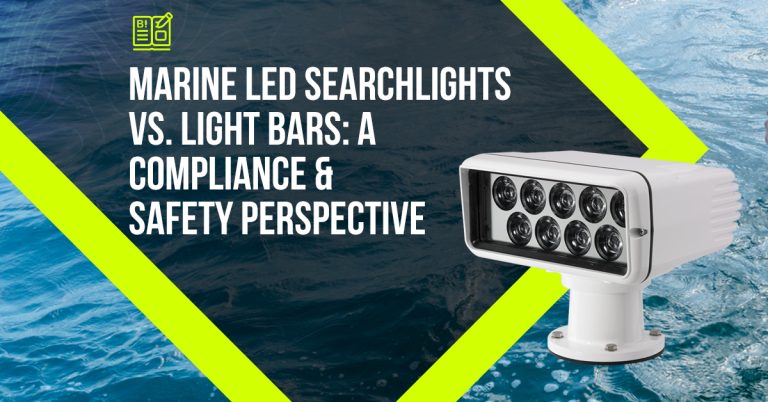
A searchlight is a high-intensity, long-range directional light designed to illuminate distant objects. It produces a tightly focused beam capable of reaching long distances ahead of the vessel. Searchlights are designed for activities including, but not limited to, locating buoys and channel markers at long distance, identifying vessels or obstacles far ahead, docking in unfamiliar areas, or navigating in total darkness both inshore and offshore
Most marine searchlights are mounted on the bow, hardtop, or radar arch and can be manually or remotely controlled, allowing the operator to sweep the beam across the horizon. The key feature is beam focus. The light is concentrated into a narrow, powerful column that travels far.
Key benefits include the following:
- Reduced Glare and Reflection – Because search lights produce a narrow beam, they create less reflection from the vessel and the water surface compared to wide-angle lighting such as LED Light Bars
- Precision Targeting – Allow operators to focus on a specific object or area
- Long-Range Visibility – Critical when navigating at speed. Distance gives you time. Time gives you options.
What Is a Boat Light Bar?
A marine light bar is a wide-angle LED lighting system designed to illuminate a broad area around the vessel. Instead of projecting light far into the distance, light bars spread light outward, illuminating large areas close to the boat. Light bars are commonly used for deck illumination, docking, loading and unloading gear, fishing operations, and slow-speed maneuvering. They provide coverage, not reach. Think of a light bar as a floodlight, not a spotlight or searchlight. They allow crews to see clearly in their immediate environment and are thereby excellent workspace tools.
However, the primary focus of this blog is the differences between marine searchlights and light bars and the fact that light bars cause increased glare and reduced night vision. This is because wide-angle lighting can reflect off the water surface and the vessel itself, creating glare which causes night blindness. Adding to this issue, light bars have reduced effectiveness in fog, rain, and spray. This is due to flood lighting illuminating water particles in the air, creating a bright wall of reflected light, which in turn negatively impacts night vision.
The Regulatory Framework
The primary international standard governing vessel lighting and safe operation is the
COLREGs (Convention on the International Regulations for Preventing Collisions at Sea). While COLREGs do not explicitly mention “light bars” or “searchlights,” they establish clear principles that directly apply. One of the key rules in the COLREGs states the following:
Operators must maintain a proper lookout by all available means
The above rule has direct applicability to Light Bars because lighting that reduces your own visibility or that of others can violate this rule. As previously referenced, Light Bars cause increased glare and reduced night vision, leading to a violation of the core COLREGs rule referenced above.
In contrast, marine searchlights are consistent with both the intent and practical application of COLREGs. This is because searchlights produce a narrow, directed beam, allowing operators to illuminate hazards without lighting the entire horizon and allowing operators to avoid shining directly into oncoming vessels which significantly reduces the risk of impairing another operator’s vision (ie. this avoids violating the COLREGs “Proper Lookout” principle referenced previously). Additionally, searchlights are typically used momentarily and intentionally, rather than left on continuously. This helps preserve your own night vision while also preventing prolonged glare exposure to others.
Having identified the inherent risk of “reduced visibility” which is associated with light bars, let’s examine some of the risk operators assume when it comes to enforcement in specific situations where it is deemed that a light bar has been used incorrectly.
Enforcement & Liability Considerations
While enforcement varies by region, authorities such as the U.S. Coast Guard and state boating agencies may take action if lighting is deemed unsafe. This could lead to citations for negligent or unsafe operation or liability in the event of a collision. In many cases, post-incident analysis will examine whether lighting contributed to reduced visibility or whether another operator was effectively “blinded.” If a light bar is found to be a contributing factor, the operator using it may be held at fault, even without a specific rule banning the device.
While the COLREGs establish the global framework for safe navigation, state boating laws are increasingly being used to enforce improper lighting use, including the misuse of forward-facing LED light bars. Importantly, most states do not explicitly ban light bars. Instead, enforcement is happening through broader legal concepts like:
- Reckless or negligent operation
- Improper display of lights
- Interference with required navigation lighting
- Failure to maintain a proper lookout
Below are key examples of laws in specific states which have led to, or can lead to, enforcement related to improper use of light bars.
Florida: Negligent Operation & Visibility Impairment
In Florida, boating laws emphasize safe operation and avoidance of hazardous behavior, with enforcement led by the Florida Fish and Wildlife Conservation Commission. As it stands, Florida law prohibits reckless or careless operation that endangers others. Therefore, if a light bar blinds another operator, obscures navigation lights, or contributes to a collision, it can be interpreted as negligent operation, even without a specific “light bar law”
Texas: Navigation Light Interference & Safe Operation
In Texas, boating regulations are governed by the Texas Parks and Wildlife Department under the Texas Water Safety Act. Applicable legal standards state that vessels must display proper navigation lights that meet visibility requirements and operators must maintain safe operation and avoid hazardous conditions. Additionally, Texas law emphasizes that failure to follow safety rules can result in fines or penalties, which can extend to lighting misuse if it contributes to unsafe conditions.
California: Reckless Operation & Local Enforcement
In California, boating safety is overseen by the California State Parks Division of Boating and Waterways and current laws state that it is unlawful to operate a vessel in a reckless or negligent manner that endangers life or property. Light bars utilized in an improper manner can be interpreted as negligent operation and there is strong local enforcement (harbor patrols, sheriff marine units) of correct light bar use with increasing scrutiny in busy waterways and harbors where glare impacts are amplified
Missouri (Example of Explicit Lighting Restriction):
Some states go further with more explicit guidance. In Missouri, the law allows spotlights for intermittent use only. Continuous display of a spotlight at night is prohibited. This is one of the clearest examples of regulatory intent since it effectively says that the use of forward light bars is not allowed when used in their primary use case (ie. continuously powered on). Instead, lighting should be temporary, targeted, and controlled. This aligns almost exactly with the proper use of searchlights, not light bars.
State boating laws are not waiting for “light bar-specific regulations” to catch up. Instead, as referenced above, certain state authorities are already enforcing existing rules to address unsafe lighting.
From a compliance standpoint, a searchlight is a controlled navigation tool that supports legal operation. Conversely, a light bar, used improperly, can expose you to citations, liability in accidents, and increased enforcement scrutiny. In today’s regulatory environment, the question isn’t whether light bars are legal, it’s whether their use can be justified as safe and responsible by the applicable authorities.
Regulations like COLREGs are built around one core principle: Every operator must act to preserve visibility and prevent collisions. It is therefore of the utmost importance to learn about the differences between marine searchlights and light bars as operators need to understand the appropriate use of the different lighting options available to them.