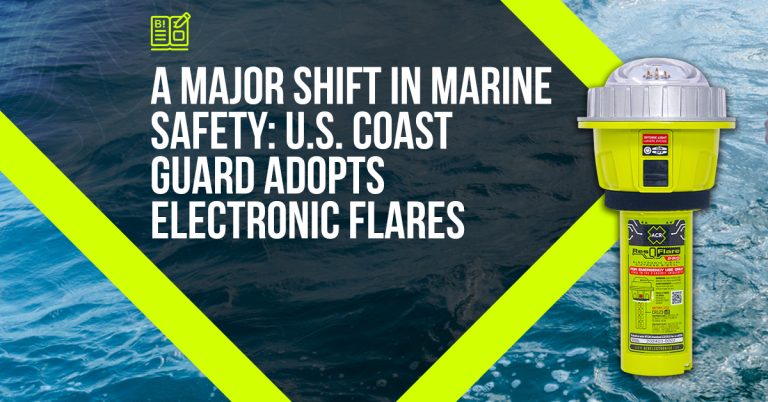
A Major Shift in Marine Safety: U.S. Coast Guard Adoption of Electronic Flares
Posted on June 1, 2026
For generations, pyrotechnic flares have been considered the standard for visual distress signaling on recreational boats. They have undoubtedly saved lives, but they also come with well-known drawbacks including limited burn times, expiration dates, hazardous storage requirements, disposal challenges, and the very real risk of burns or accidental fires.
Today, there has been a major shift in marine safety through the U.S. Coast Guard adoption of Electronic Flares. In May 2025, the U.S. Coast Guard announced a major change to its own boating operations. Through All Coast Guard Announcement (ALCOAST 234/25), the Coast Guard directed that approved Electronic Visual Distress Signaling Devices (eVDSDs) must replace traditional MK-124 pyrotechnic distress signals aboard Coast Guard boats no later than April 1st, 2026. According to the USCG announcement, this transition “enhances safety by providing a more reliable and longer-lasting distress signaling capability” while also reducing the administrative burden associated with pyrotechnic flares. That’s a remarkable statement coming from the organization responsible for protecting America’s waterways.
When the Coast Guard Leads, Boaters Should Pay Attention
The U.S. Coast Guard evaluates safety equipment under the harshest real-world conditions imaginable. Their crews operate in severe weather, at night, in heavy seas, and often in life-or-death rescue situations. When an organization with that level of operational experience decides to replace a decades-old safety technology, it’s worth asking why.
The Coast Guard specifically cited several key advantages of electronic distress signaling devices:
- Increased visibility through bright, consistent LED signaling.
- Significantly longer operating life than traditional pyrotechnic flares.
- Elimination of the hazards associated with handling burning pyrotechnics, including burns, accidental ignition, and misfires.
It’s important to note that the above advantages of electronic flares are not marketing claims, they are the reasons the Coast Guard itself provided for making the transition.
Why Electronic Flares Make Sense for Recreational Boaters
While ALCOAST 234/25 applies to Coast Guard vessels rather than recreational boats, the same safety advantages apply to everyone on the water. Think about the typical recreational boating emergency. Stress levels are high. Visibility may be poor. Family members or guests, not experienced mariners, may need to operate your emergency equipment. In those moments, simplicity matters.
An electronic flare such as the ResQFlare PRO can be activated with the push of a button. There is no open flame, no molten slag, no hot casing to hold, and no concern about igniting fuel vapors or inflatable life rafts. Instead of burning for only a short period before becoming useless, an approved electronic flare continues operating for hours, dramatically increasing the opportunity to be seen by rescuers.
Modern Technology for Modern Boating
Virtually every aspect of boating safety has evolved.
Paper charts became GPS chartplotters.
Analog radios became DSC-enabled VHF radios.
Emergency beacons became GPS-enabled EPIRBs and Personal Locator Beacons.
Visual distress signaling is undergoing the same evolution. The Coast Guard’s decision recognizes that today’s LED technology offers meaningful advantages over a technology developed decades ago.
A Smart Choice for Every Boater
No one buys safety equipment hoping to use it. But everyone hopes it will perform flawlessly if the day ever comes. The U.S. Coast Guard has made its decision for its own fleet by transitioning away from pyrotechnic distress signals in favor of approved electronic visual distress signaling devices because they provide greater reliability, longer operation, and improved safety. That decision should give every recreational boater confidence that making the switch is more than simply adopting new technology, it’s adopting a safer approach to emergency preparedness.
Given the U.S. Coast Guard adoption of electronic flares, the nation’s premier maritime safety organization believes electronic flares represent the future of visual distress signaling. That’s a compelling reason for recreational boaters to seriously consider making the same transition. Because when it comes to safety on the water, following the Coast Guard’s lead is rarely the wrong course.