Zachráněné životy
2

Boating

Ocean
ACR ResQLink Rescue in Pungo Sound After Endurance Race Capsize
35.510799696501°N, -76.603942871094°W
Posted on October 5, 2026 by Arnold Hite
What happened?
My son and I were competing in a 300-mile endurance sailboat race in an 18-foot sloop. On the morning of our capsize, a north wind blew at around 20 mph as we headed south through the mouth of the Alligator River toward North Carolina’s Outer Banks. We had set no reefs, and the centerboard and rudder vibrated as they sliced through the waves. The boat lifted and pounded across the wave tops with each gust. We were moving fast, and it felt exhilarating.
By late afternoon, we entered Pungo Sound. To stay on course, we needed to make two jibes. The first came at around 3 p.m. It was tricky, but it worked. An hour later, about a mile north of Belhaven, North Carolina, we attempted the second jibe.
Small boats can make heavy-air jibes difficult and violent. In hindsight, we held the mainsail too close. Before we could let it out, the boat capsized. Everything changed in seconds. I saw my son fly over me as his side of the boat rose and my side went into the water. Lines surrounded us, and I quickly became tangled. My son managed a little better.
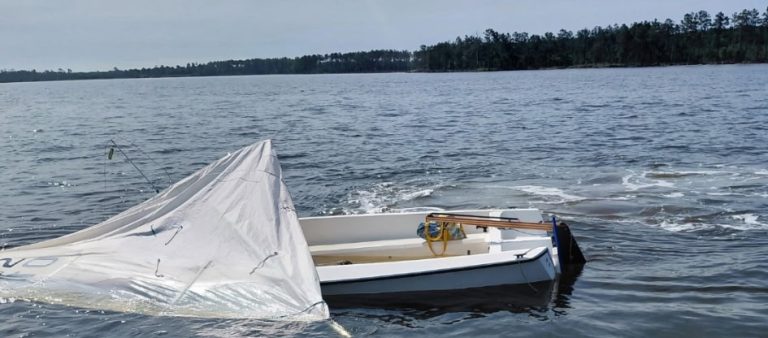
After we untangled ourselves, we secured the gear we could reach. Then we tried to right the boat. It lay over at about 45 degrees. The mast tip caught on the bottom and stopped the boat from fully turning upside down. Normally, standing on the centerboard gives enough leverage to right a small sailboat. Our boat’s design gave us no way to pull the board down, however. The board had lifted into its housing, and the one-foot swells made every attempt harder.
For an hour and a half, we tried to right the boat. Eventually, we used a piece of sailing equipment to pry the centerboard free. I climbed onto it to provide leverage. The boat started to rise, and I hoped we could sail the three-quarters of a mile to shore.
Instead, the boat had taken on too much water. As it righted, it rolled onto its other side and lay mostly upside down again. We were exhausted, cold, and losing daylight. We activated our ResQLink AIS PLB because we had no other safe option.
Two hours later, the Coast Guard arrived. Seeing them was an enormous relief. The boat was slowly sinking, the sun had set, and we were cold. This PLB rescue brought help when my son and I could no longer get ourselves safely ashore.
Words of wisdom
My son and I are experienced sailors. We’ve had sailboat blowdowns before. I feel we were well prepared. But, as time went by, we were unable to right the boat. It is difficult to decide when to stop trying, and when to setoff the PLB. For us, after 1.5 hours of attempting to right the boat, hypothermia began to be a real possibility. For me the decision came easy after I realized we were beginning to shiver and night was approaching. Still, hindsight haunts me. Perhaps if I had done this, or changed that, things would have been different. Hindsight is useful, but it is an unfair way to evaluate decisions that needed to be made quickly and under stress.
Thank you note
Thank you for a well made product. It worked just as we had practiced. If you are looking for ways to improve it, I suggest you make it shorter and fatter. It’s long length will not fit in any PFD pocket I tried. I tried many. If you can’t be made shorter, then lobby PFD makers to provide a pocket that will accommodate it.
Rescue location
Belhaven, NC, USA
Rescue team
Coast Guard